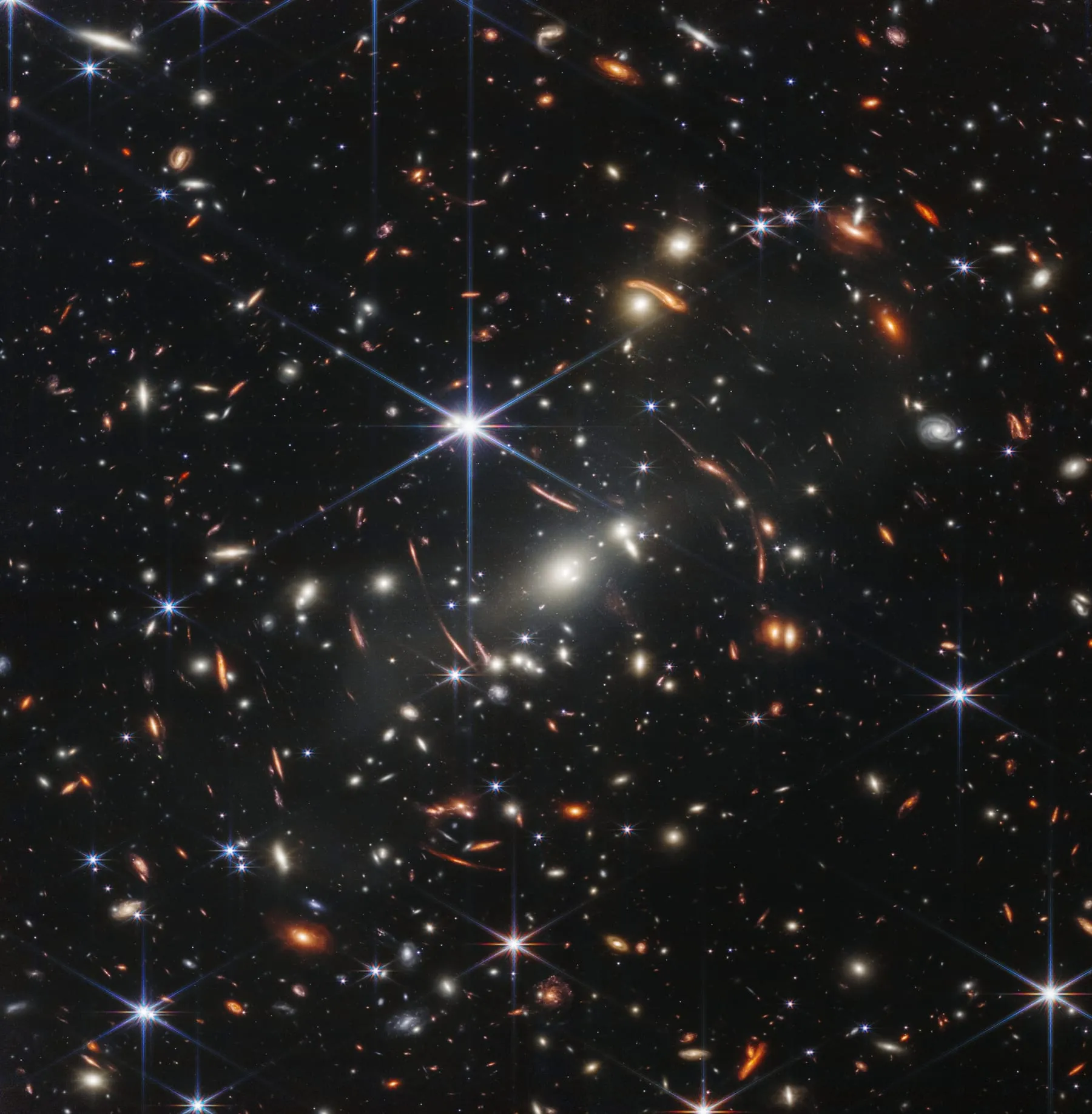
Since it opened its eye in 2022, the James Webb Space Telescope has kept returning the same puzzle. Scattered across the early universe are small, intensely red points of light. There are hundreds of them. They are too compact to be ordinary galaxies and too strange to fit any neat category, so astronomers gave them the placeholder name they deserved: little red dots. Nobody could say for certain what they were.
On 12 August a team writing in Nature put forward the cleanest answer yet, and it is a peculiar one. The object they describe is a black hole that has wrapped itself in so much gas that, from a distance, it wears the disguise of a colossal star. They call it a black hole star. Its catalogue name is MoM-BH*-1.
What Webb actually saw
The light from MoM-BH*-1 left it about 13 billion years ago, when the universe was only 660 million years old. That is early. We are looking at the cosmos close to its dawn, before most of the galaxies we know had formed.
The giveaway was a feature in its spectrum called a Balmer break, a sudden step down in brightness at the wavelengths where hydrogen absorbs light. A Balmer break is normally the fingerprint of stars. This one was extreme. The light dropped by roughly a factor of eight across the break, one of the deepest ever recorded. For comparison, the bright star Vega shows a step of less than three.
That is Rohan Naidu of the University of Hawai’i, the study’s first author, describing the find. The break is so strong that a crowd of ordinary stars cannot easily produce it. What can is a black hole swallowing matter at a furious rate, surrounded by dense hydrogen gas that is thick enough to absorb and redden the fierce light coming off the disk. The gas does the work that a population of stars was assumed to be doing. The star is a mirage. The engine underneath is a black hole.
Why it matters beyond one strange dot
If MoM-BH*-1 is what the team thinks it is, it is a Rosetta stone for the wider mystery. The little red dots have resisted explanation because their spectra carry signals that seem to belong to stars and to accreting black holes at the same time. An isolated black hole star, caught with the stellar disguise but without a bright host galaxy muddying the picture, shows how one object can produce both signals at once. Mix a black hole star into a young galaxy and you may get exactly the spectrum of a typical red dot.
The survey that found it is honest about the doubt. It is called Mirage or Miracle, a name that admits the two readings of every one of these objects. Read one way, the little red dots are a trick of gas and dust and there is no new physics to see. Read the other way, they are enormous black holes that grew impossibly fast in the first few hundred million years, faster than the standard account of how black holes are seeded allows.
Either answer is worth having. If these are mirages, a long-standing anomaly dissolves and the early universe stays roughly the shape we drew it. If they are miracles, then something was making giant black holes at cosmic dawn by a route we have not written down, and the timeline of the first billion years needs redrawing. A single well-observed object cannot settle that. What it can do, and what this one does, is turn a vague population of red smudges into a specific claim that the next round of telescope time can test.
For now the tape is still being read. But the universe has handed us an object that is a black hole and a star at the same time, at a moment when it should have been too young to build either.
Image: NASA, ESA, CSA, STScI. Finding published in Nature, doi:10.1038/s41586-026-10846-4.