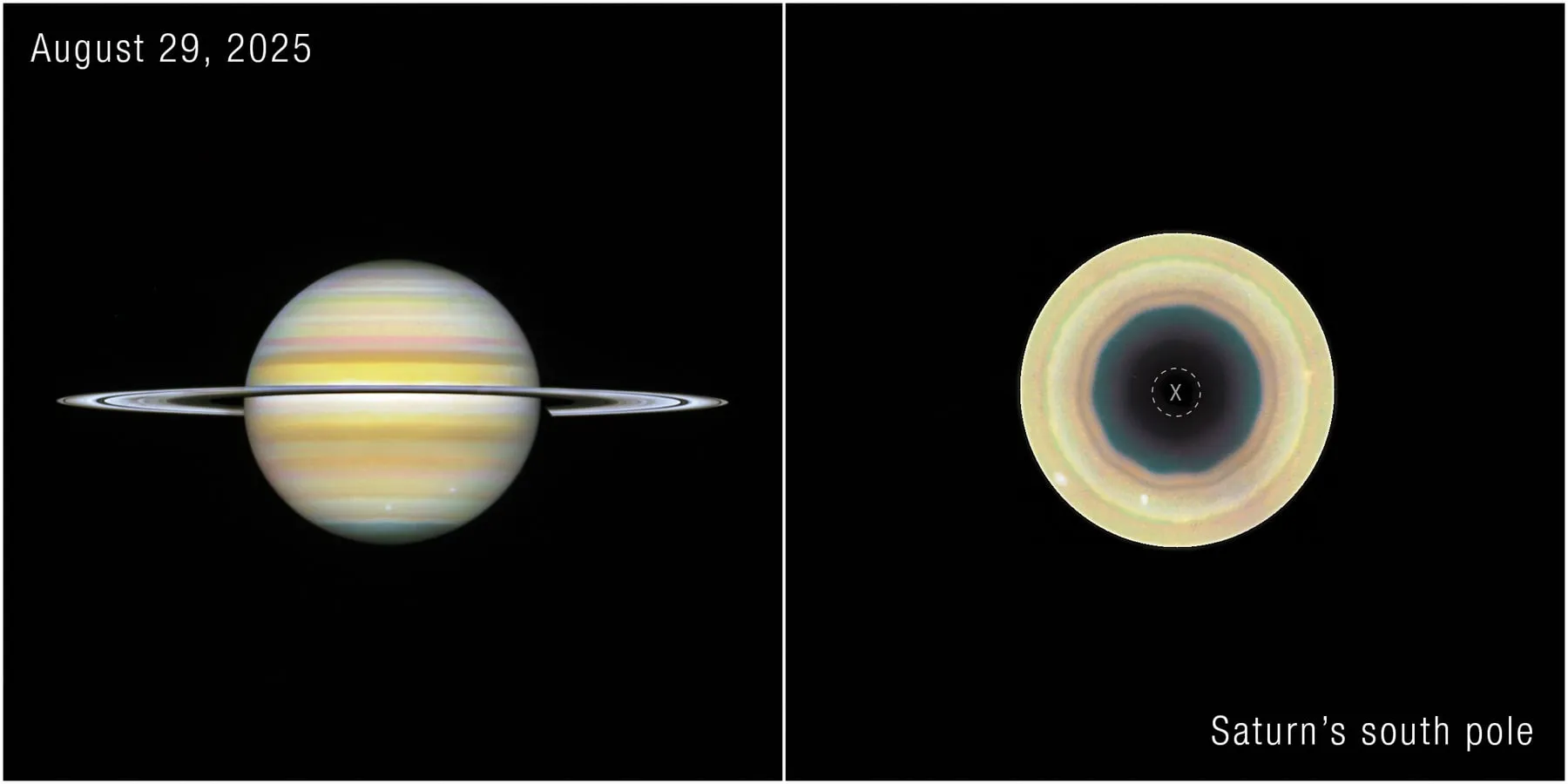
Saturn has a hexagon at its north pole. It is roughly the width of two Earths. It is a jet stream rather than anything solid, and it has been sitting there, with six sides, for every look anyone has taken at it since the Voyager flybys of 1980 and 1981. It is one of the strangest persistent objects in the solar system, and the obvious question it raises has been open for forty years: if the planet’s wind system is broadly symmetric north to south, why is there nothing like it at the bottom?
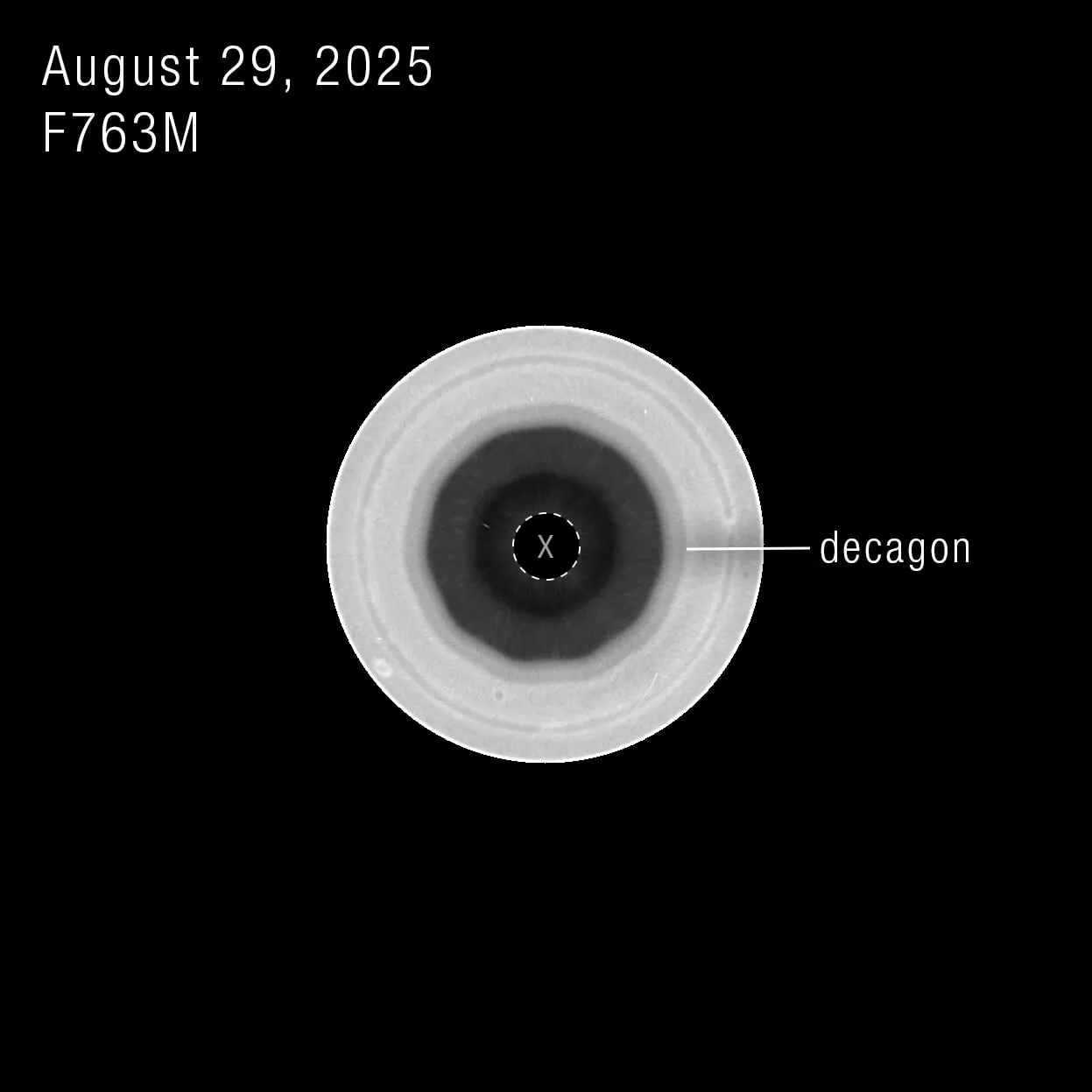
On 2 September, the Hubble team answered that. There is something like it at the bottom. It has ten sides.
What they found
The release describes a giant atmospheric wave encircling Saturn’s south pole with ten distinct sides, the first large regular sided jet pattern ever seen in the southern hemisphere. The paper is in Science Advances.
Two details make this more than a curiosity.
The first is that the decagon sits inside Saturn’s jet streams and extends through multiple layers of the atmosphere. It is not a pattern painted on the cloud tops. It is a vertically extended structure, which is what you would expect from something driven by the planet’s wind system rather than by local weather.
The second is that it is still arriving. The northern hexagon has looked the same for four decades. This one does not. Hubble data from 2023 onward shows it developing. Ground based observers saw hints of it in 2024 and a stronger signal in 2025, and the astronomers describe it as actively strengthening. Amy Simon of NASA’s Goddard Space Flight Center, who leads the Hubble programme that caught it, put it plainly: “We’ve never seen anything quite like this in Saturn’s southern hemisphere.” The northern hexagon, she notes, “has been there every time we’ve looked for more than 40 years.” This one is giving astronomers something they almost never get, which is the chance to watch a giant atmospheric pattern form while they are looking at it.
Forty years of looking in the wrong season
Agustín Sánchez-Lavega of the University of the Basque Country, the paper’s lead author, has been on this specific question for most of his career. “Given Saturn’s symmetry in its north-south jet stream system, we have been searching for a counterpart to Saturn’s northern hexagon on the south pole in Hubble images since 1990,” he says.
Thirty five years of looking, and then it turns up. Part of the reason is that Saturn’s year runs about 29 Earth years, so a season there lasts seven of ours. Pointing a telescope at the right pole in the right illumination at the right point in that cycle is not something you can arrange on a schedule. You wait.
Which is the real lesson from the programme that found it. This came out of OPAL, a Hubble effort that photographs the outer planets every year specifically so there is a long record to look back through. Mike Wong at the University of California, Berkeley makes the point directly: “When we started the OPAL program, we expected compelling surprises but we didn’t know what to expect specifically. A lot of the discoveries we see coming from OPAL are not just based on one observation, but on years and years of data.”
Why a polygon
The honest answer is that we have a good guess and not a proof.
The leading explanation is that these shapes are a wave trapped in a fast circumpolar jet. A ribbon of wind circling the pole can go unstable and buckle, and if the buckling settles into a standing wave that fits a whole number of wavelengths around the circle, the jet stops being a circle and becomes a polygon with that number of sides. Laboratory work backs this up: spin a tank of fluid fast enough and you can produce polygonal flows on a bench, with the number of sides depending on how fast the fluid turns relative to the container.
If that is right, then six sides at the north and ten at the south is not a contradiction. It is the same mechanism running at different speeds, and the side count is telling you something about the jet underneath. What it is telling you exactly, nobody has nailed down.
This is the same family of physics as the trailing vortices behind an island, and the same equations that ten thousand AI agents spent eighty eight hours arguing about last month. Fluid dynamics is full of this. The equations are written down, the behaviour is visible from a telescope, and the connection between the two is still partly guesswork.
Saturn has been there the whole time, turning once every ten and a half hours, carving a shape into its own atmosphere that nobody predicted and nobody can fully explain. We only know about it because a telescope programme kept taking the same photograph for twenty years and somebody looked at the stack.
Image: NASA, ESA, STScI, A. Sánchez-Lavega (University of the Basque Country), A. Simon (NASA-GSFC), M. Wong (UC Berkeley); Image Processing: A. Pagan (STScI), CC BY 4.0.