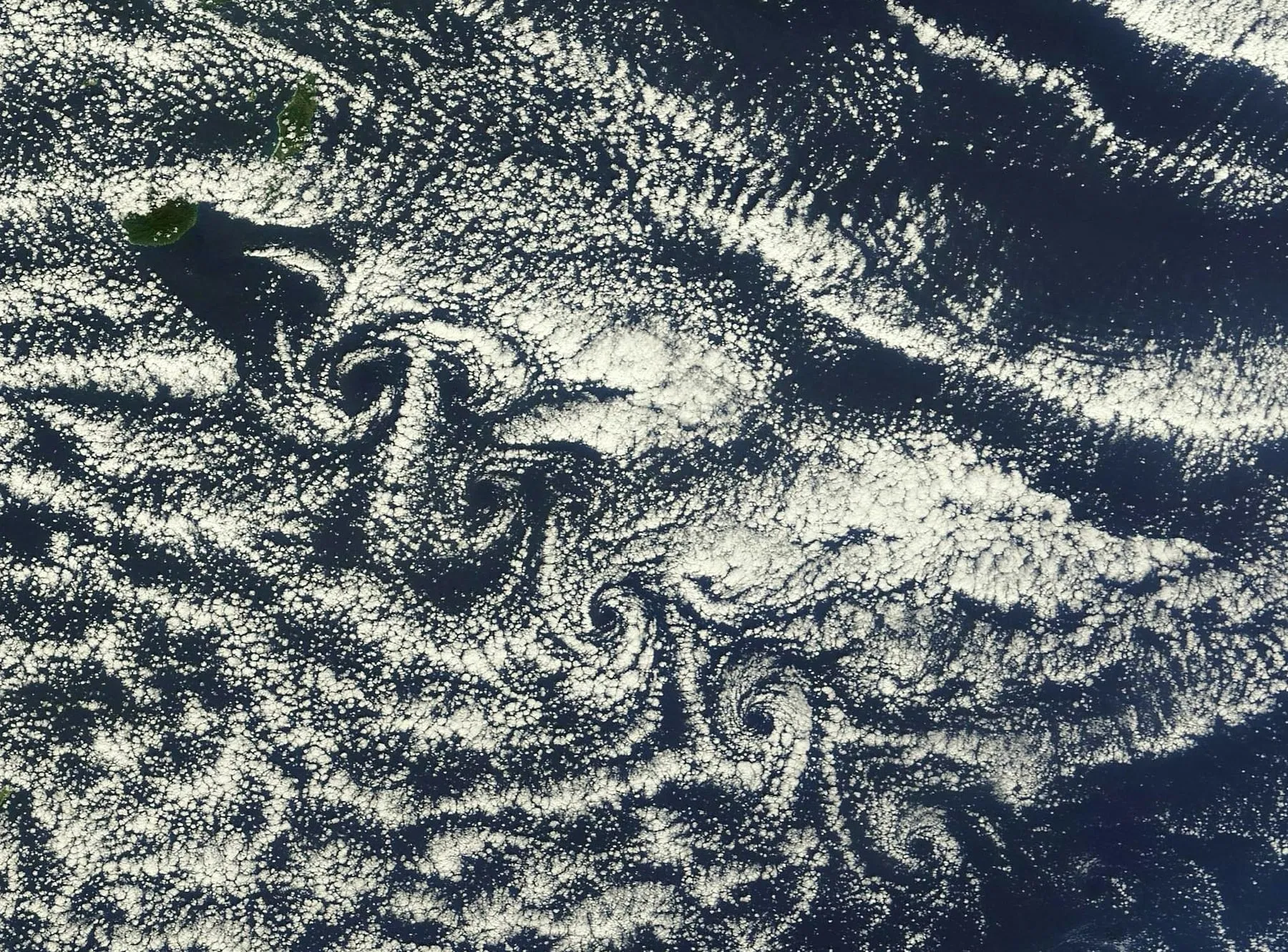
The picture above is a fluid obeying the Navier-Stokes equations. Air moves past an island and the flow breaks into a trailing double row of vortices. The whole pattern is described by a handful of lines written down in the 1840s. We use those lines to design aircraft, forecast weather and model blood flow. What nobody has been able to do, in more than a century and a half of trying, is prove that their solutions always stay sensible.
That is the Navier-Stokes existence and smoothness problem, one of the seven Millennium Prize problems the Clay Mathematics Institute attached a million dollars to in 2000. Six of them are still open. On 8 September, OpenAI published a page titled “On the Navier-Stokes Millennium Prize Problem” and said a system of its agents had resolved one.
What was actually claimed
The claim is specific, and the specificity matters.
OpenAI says its system produced a proof that an initially smooth fluid, at rest, with a smooth external force applied to it, can develop a singularity in finite time while its total energy stays bounded throughout. A singularity here means the mathematics blows up: some quantity in the solution runs to infinity at a point, and the smooth description of the fluid stops existing. The company published both a written proof and a formalisation in Lean, a proof assistant that mechanically checks every step of an argument against its own foundations.
It also described how the proof was found. Agents were split into groups that could talk inside each group, and the group that produced the Navier-Stokes result ran on the order of 10,000 concurrent agents, coordinated by an internal model the company has not released. Quanta Magazine, which covered the result on the day, reports that the proof took about 88 hours of that work, that formalising it in Lean took a further 17 hours or so and that the agents exchanged close to five million messages along the way.
Those are two different things, and the gap between them is where this story lives. A Lean formalisation is strong evidence that a proof contains no logical hole. It says nothing about whether the theorem proved is the theorem the Clay Institute wrote down. The prize has not been awarded. Independent verification by mathematicians who do not work at OpenAI is still running, and until it finishes, the honest description of the status is unresolved.
The race, and the accusation
Twelve hours before OpenAI posted, Tristan Buckmaster at New York University had announced results of his own, with Levent Alpöge, a researcher at Anthropic. The pair had been working on the problem for the better part of a year, using models from both OpenAI and Anthropic, and had arrived at results on the related 3D Euler equations plus an unverified blowup proof for an easier version of Navier-Stokes. Buckmaster said one of the three papers they released could only be described as AI slop, which is a level of candour the rest of this story could use more of.
OpenAI concedes priority on Euler to Buckmaster and Alpöge, and claims Navier-Stokes for itself. It also admits that it only went after the problem because of rumours that the pair were closing in on it.
Then it gets worse. In Fortune’s account, Buckmaster alleges that the OpenAI researcher Sebastien Bubeck offered him an arrangement: Buckmaster could publish and claim the prize, provided he credited OpenAI’s solution and removed Alpöge’s name because of where Alpöge works. When Buckmaster declined and said he would go public, he alleges Bubeck asked him why he would ruin his career, and told him that if Buckmaster did not want him to be nice, he did not have to be nice. Buckmaster has also raised the question of whether OpenAI’s system saw his own Codex sessions.
Those are allegations, not findings. They are also the part of the episode that will still matter in a year, because they are about conduct rather than mathematics, and conduct is not something a proof assistant can check.
What the mathematicians are worried about
Terence Tao, who has worked on this exact problem for years, did not respond with a benchmark score. He objected to AI companies treating open mathematical problems as marketing proof points, and warned about what happens to a field when its unsolved problems are consumed rather than worked through. His phrase for it was “the indiscriminate strip-mining of open problems for solutions”, and his worry was that this may destroy the ecosystem that the next generation of techniques, problems and practitioners would otherwise have grown out of.
That is not a complaint about AI being bad at mathematics. It is the opposite. It is a complaint about what a field loses when the hard problems get cleared at industrial speed by systems that produce an answer without producing anybody who understands why it is the answer. The output survives. The apprenticeship that used to come attached to it does not.
Where this leaves things
Three things are true at once, and the coverage has mostly picked one.
A machine checked proof of a finite time singularity in forced Navier-Stokes would be a genuine result, and the Lean formalisation is not nothing. It is also true that the Clay prize is unclaimed, that the variant proved is not obviously the variant the prize describes and that independent verification has not finished. And it is true that the first serious collision between a frontier lab and the mathematical community over credit happened in the same week, and that the lab came out of it looking worse than its model did.
The equations in that satellite photograph have been resisting proof since 1934, when Jean Leray showed weak solutions exist without being able to show they stay smooth. They may have stopped resisting in September. We will know when the people whose job it is to check have finished checking, and not when a launch page says so.
Image: NASA, MODIS Rapid Response System. Public domain.