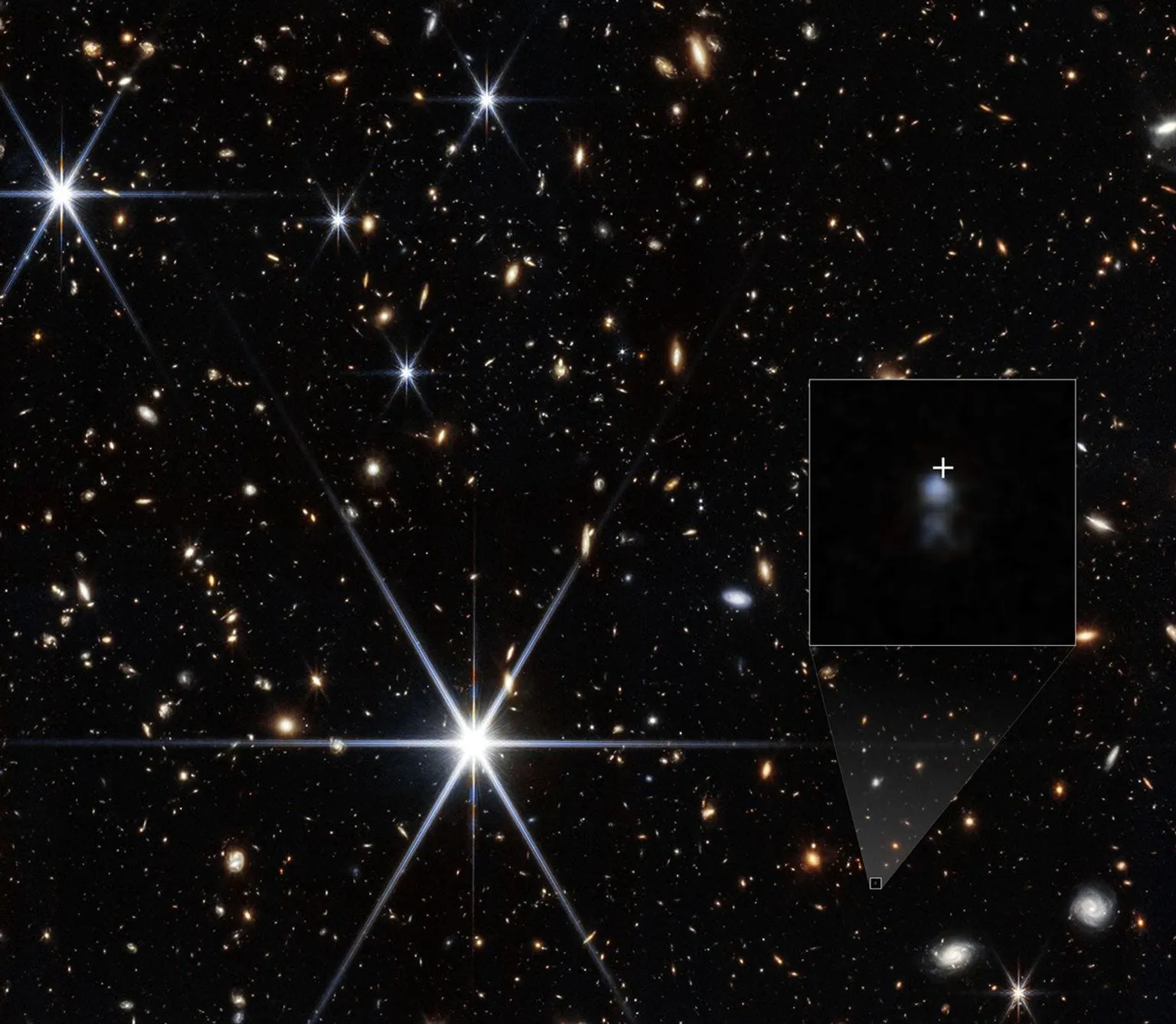
A fast radio burst is a flash of radio emission that lasts a few milliseconds. The first one was reported in 2007. The bursts are bright enough to cross the universe, and they arrive as a short, sharp pulse with no warning.
FRB 20240304B was detected by the MeerKAT telescope on 4 March 2024. On 8 October 2026, NASA published the result of a Webb observation that measured how far away it came from. It is the farthest known fast radio burst.
How far away it is
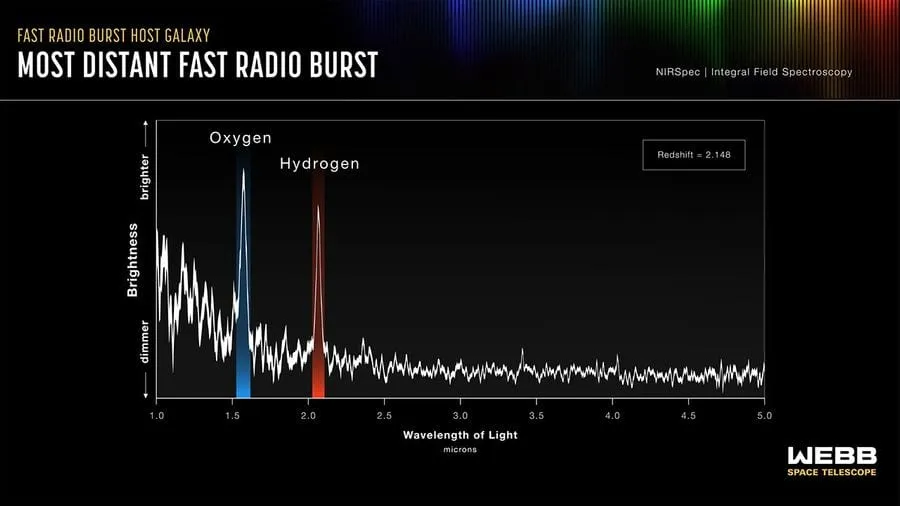
The host galaxy has a redshift of 2.148, according to a spectrum taken with Webb’s NIRSpec instrument. In plain terms, the light from the galaxy has been stretched by the expansion of the universe, and the stretch puts the galaxy about 3 billion years after the Big Bang.
That distance is the headline, but the galaxy is the real finding.
A galaxy that is too small
The team expected the host to be a big, well-formed galaxy full of stars. Most fast radio bursts with a known host sit in massive, star-forming galaxies. This one does not.
The host is a small dwarf galaxy, still forming stars, and it is about 1,000 times less massive than the team expected. Ben Stappers of the University of Manchester, one of the co-authors, put it plainly: the host “sticks out in the whole galaxy sample that we have.”
Lead author Manisha Caleb of the University of Sydney put the expectation this way: “We thought it would be a big, nicely formed galaxy with lots of stars.” The data showed a small one.
Two explanations, one of them ruled out
Two explanations have been on the table for a while. One is the merger of two neutron stars. The other is a single young, highly magnetic neutron star, a magnetar, that produces the burst through starquakes shortly after a supernova.
The team leans against the merger. Caleb’s words on that were direct: “Our work suggests that it’s very unlikely that this FRB was produced by a merger.” Neutron star mergers take billions of years to happen after the stars form. That timing favours older galaxies, and this host is young.
A young magnetar fits a young galaxy. That is the argument, and it is an argument rather than a proof. The team is saying the evidence points one way, not that the question is closed.
Why this matters beyond one burst
Working out where fast radio bursts come from is hard because the bursts are short and they leave almost nothing behind. Matching one to a host galaxy is the first step, and the host then tells you what kind of object could have made the burst.
A host at this distance also has a second use. The light from a burst passes through the material between us and the source on the way, and that material leaves a signature in the signal. Bursts from distant hosts are useful for measuring the gas that fills the space between galaxies.
NASA’s own release describes the origin as a suggestion, not a settled result, and that is the honest way to read it. One burst, one galaxy and one spectrum make a strong case. They do not make a catalogue.
Image: NASA, ESA, CSA, STScI, Themiya Nanayakkara (USYD). Image Processing: Joseph DePasquale (STScI). Public domain.