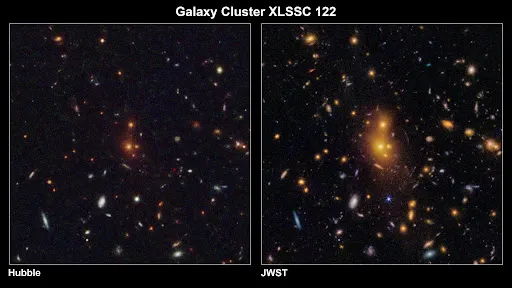
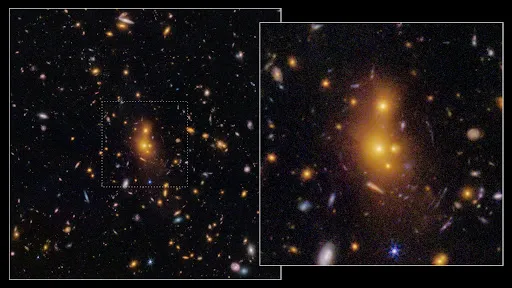
The cluster is called XLSSC 122. It is about 10.4 billion light years away, which means the light reaching Webb left it when the universe was a little under a quarter of its present age. It is a collection of galaxies held together by dark matter, and it is the most distant known cluster that bends light strongly enough to stretch background galaxies into arcs. That is a rare property, and it is the reason anyone looked closely at it.
Lensing is how the mass gets weighed. A cluster’s gravity bends the light of everything behind it, so the arcs tell you how much mass is there and where it sits, whether or not any of that mass shines. The result from Webb is that the mass is concentrated in the middle to a degree the models do not predict for a cluster this old.
What the team found
The results come from several papers led by Kyle Finner of Caltech’s IPAC, with follow-up work by Zachary Scofield and Hyungjin Joo of Yonsei University. The headline findings are these.
- It is the most distant known galaxy cluster with strong gravitational lensing.
- Its mass is highly concentrated at the centre, and that conflicts with the cosmological models for that early epoch.
- Dark matter, not visible matter, dominates the lensing.
- Weak lensing, along with X-ray and radio data, shows the cluster is still merging.
- The team made the earliest known detection of intracluster light, the faint starlight drifting between galaxies, and its shape tracks the dark matter.
The cluster was first flagged in an X-ray survey in 2014 by ESA’s XMM-Newton. Hubble helped pin down its distance. Webb supplied the detail that turned it into a measurement, because its infrared view picks up the lensed arcs that Hubble alone could not separate cleanly.
Why the centre is the problem
Clusters form by gravity pulling matter together over billions of years, and the models predict how that mass should spread out. In a young cluster it should be looser and more evenly distributed than what Webb sees. Finner put the mismatch plainly: “it has a mass concentration that doesn’t agree with our cosmological model predictions.”
There are two ways to read that. The first is that the models are missing something about how fast structure can form in the early universe. The second is that the cluster is in an unusual state, merging with another structure and bunching its mass up as it does. The team’s data points to both possibilities, and it does not yet say which one dominates.
The light that traces the invisible
The most interesting part of the work may be the intracluster light. Stars do not stay in their galaxies all the time. Some drift out into the space between them, and in a massive cluster that diffuse starlight builds up into a faint glow. Finner’s team found that this glow follows the dark matter map closely. “In this cluster, the intracluster light essentially traces the dark matter,” Finner said.
That matters because dark matter does not emit light. The stars do, and their distribution is a proxy for the invisible mass underneath. If the stars have already collected in the right places this early, the cluster must have built itself up quickly.
Why it matters that Webb could do this
Finner put the instrument’s role directly: “Before JWST, we couldn’t do this level of science in the early, distant universe.” Hubble could see the cluster, and the X-ray and radio data could see its hot gas. Only Webb’s infrared sharpness could see the faint, distant galaxies and arcs well enough to put a number on the mass.
Finner also sees this as the start of something larger. “XLSSC 122 is one of the first clusters we know of that formed in the universe,” he said, and the team hopes to find dozens more through wide area X-ray and radio surveys. Each one adds a data point, and if the models keep failing on the early clusters, the failure becomes the most useful result.
The honest position for now is that one cluster is not a theory. It is an anomaly measured carefully enough to be worth explaining. The models will either bend to fit it or they will need a new ingredient, and the next dozen clusters should show which.
Image: NASA, ESA, CSA; Kyle Finner (Caltech/IPAC), image processing Robert Hurt (Caltech/IPAC-SELab). Sources: IPAC news, 17 June 2026; ScienceDaily, 13 October 2026, from a Webb release.