Look at a stellar nursery with a normal telescope and you see the dust. The clouds are thick enough that the stars forming inside them are mostly hidden, and the part of the sky that matters most is the part you cannot see. NGC 7129 is one of those places. It sits about 3,300 light years from Earth, and on 6 October 2026 the Webb team released a new image of it that cuts through the dust.
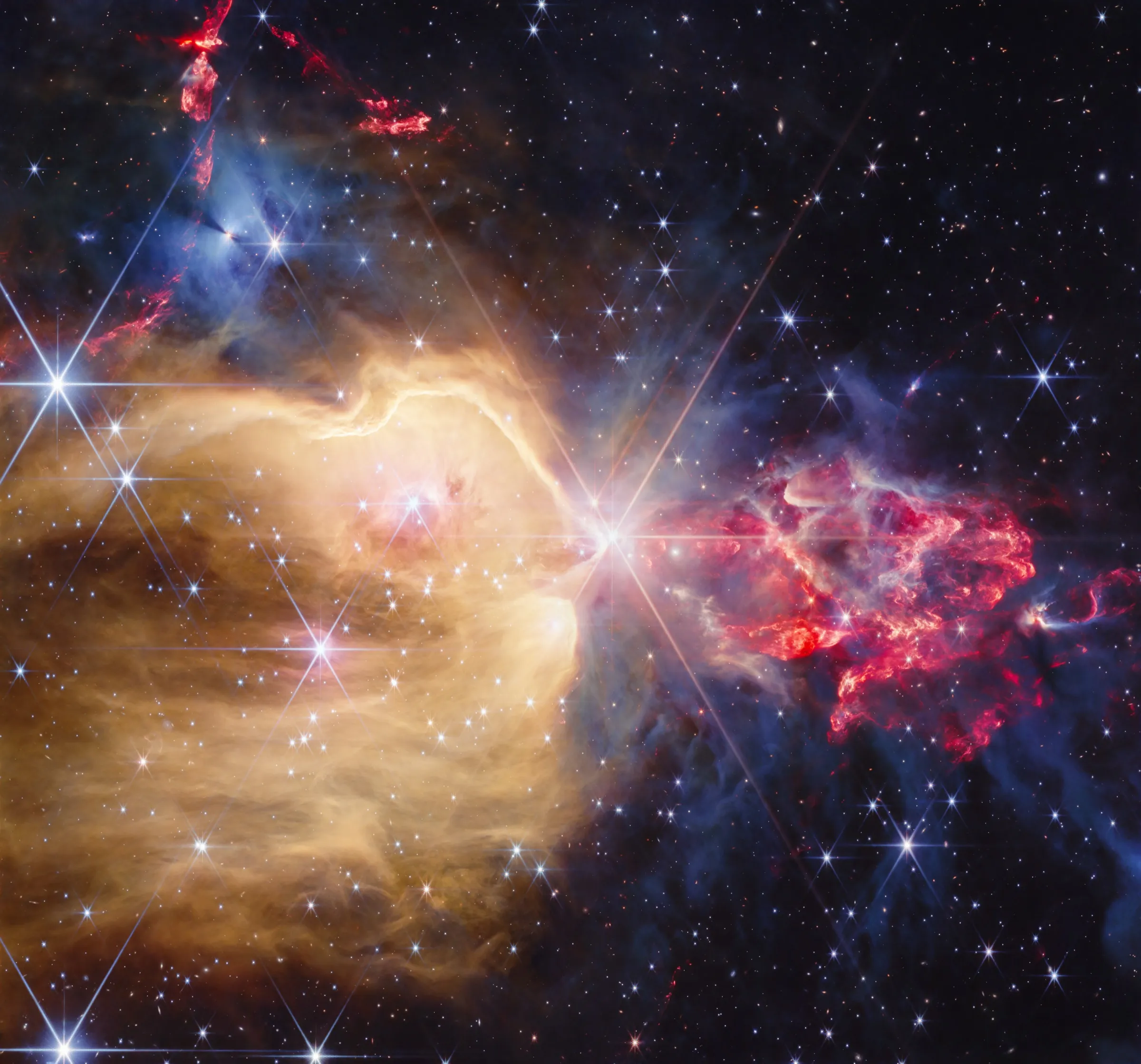
What Webb can see here
Visible light is absorbed and scattered by the fine dust in a cloud. Infrared light has longer wavelengths and gets through much more of it. That is the trick Webb is built around, and in a nursery like NGC 7129 it turns a dark, tangled region into a census of stars at different stages of their lives.
The release says Webb’s view reveals many stars that were hidden by the dust, all at different stages. Some are fully formed. Others are still gathering their mass. The image does not separate the two by eye, and it is the detail that will take the astronomers longest to work through.
The central star
The bright star near the middle of the frame is LkH(alpha) 234. It is a pre-main-sequence star, which means it has formed but has not yet settled into the steady burning that defines a mature star. It is roughly five to eight times the mass of the Sun.
A star that size does not sit quietly in its cloud. It pushes material out through outflows and shines hard enough to reshape the gas around it. The release describes it as shaping its surroundings through outflows and light, which is the mechanism that will decide how much of the nursery is cleared and how much is left to make more stars.
Younger stars, chaotic flows
Further along the frame, toward the right, the younger protostars are still embedded in their own cocoons. They drive outflows of their own, and the release calls these chaotic. That word is apt. A protostar’s outflow is not a single neat jet. It is gas pushed outward, and in a crowded nursery those flows can collide with one another and with the cloud around them.
The data will help astronomers work out how stars like these reshape the gas and dust they were born in. Each outflow that clears a path changes where the next stars can form, which means the nursery’s future is partly set by the stars already in it.
Why it is worth looking at again
Most nursery images show the glamour. This one shows the process. Webb is not looking at a finished picture. It is looking at a region in the middle of changing, with the young stars caught at different points along the same road.
The release is short and it does not carry a headline result. It is a reminder that a lot of astronomy is not a single discovery but a steady accumulation of places looked at clearly. NGC 7129 will be useful to researchers for years, mostly because it was photographed well at the moment when its young stars are still sorting themselves out.
Image: ESA/Webb release weic2620 (6 October 2026). Webb is an international partnership between NASA, ESA and the Canadian Space Agency. Source: esawebb.org/news/weic2620/.