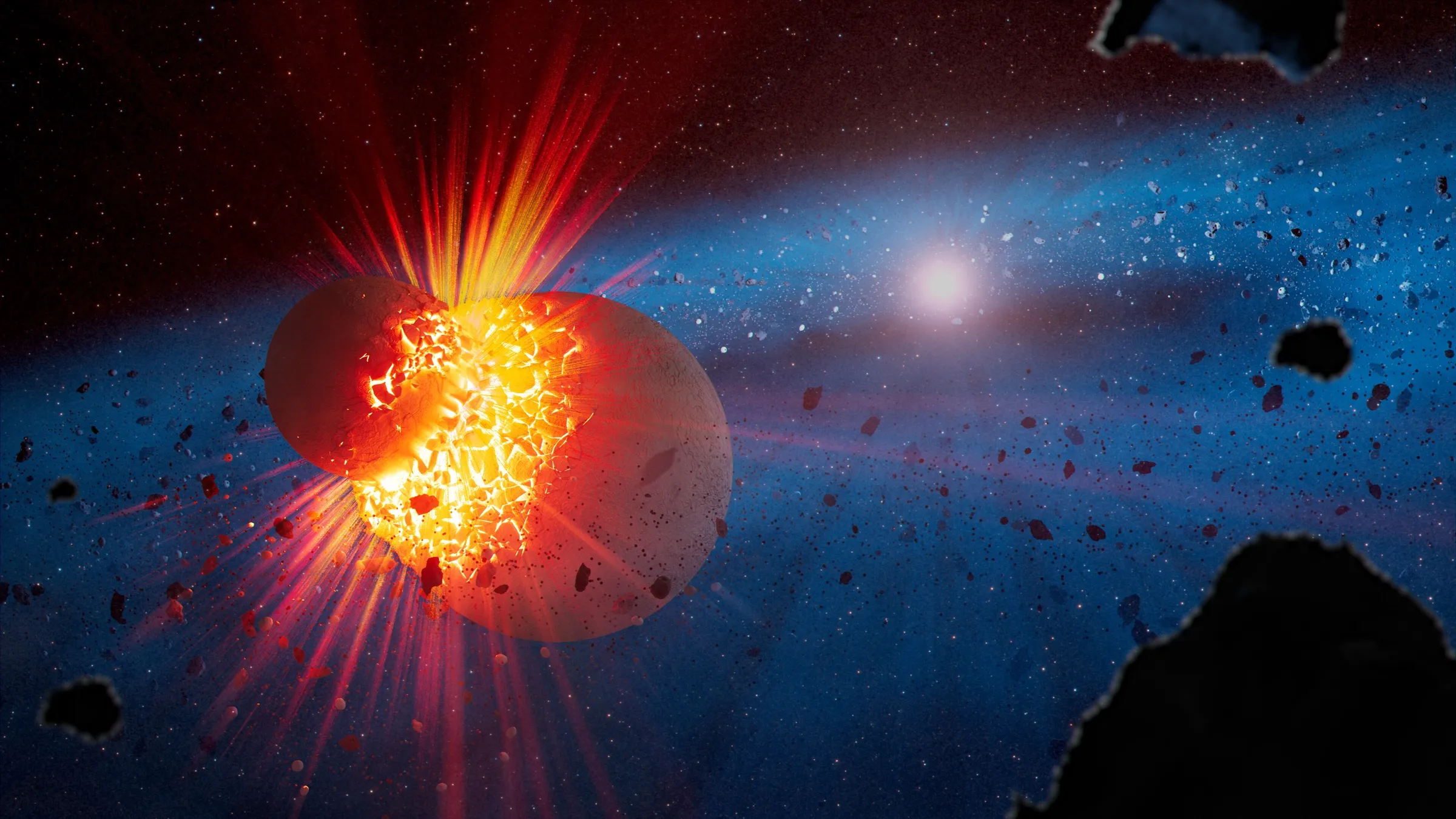
Planets are built from collisions, and the Solar System’s own story is full of them. The Moon is thought to have formed after a Mars sized body struck the young Earth, but nobody has a direct record of that impact. What astronomers can look at is the debris left behind when collisions happen around other stars. On 1 October 2026 a team using Webb reported on 21 of the rarest of those systems.
They are called extreme debris discs. They sit around young stars, and they are unusual in the mid infrared, where Webb works best, because they are unusually warm and their brightness changes over time. The team, led by Kate Su of the Space Science Institute in Boulder, Colorado, said the sample is the largest of its kind.
Two kinds of dust
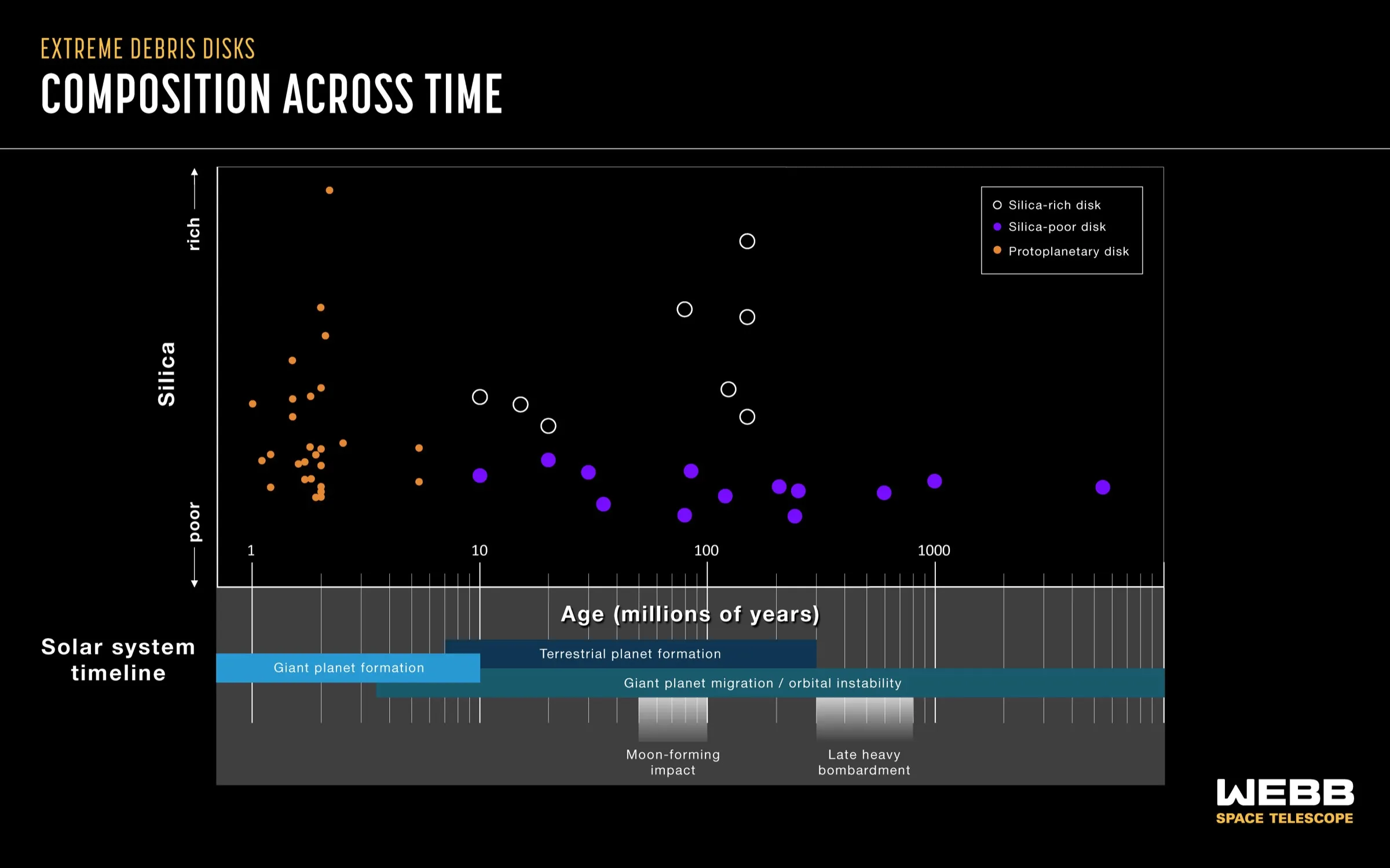
The most useful thing about the dust is what it is made of. The discs fall into two chemical families, and the split is about silica.
About one third of the discs are silica rich. The team says these likely formed from high energy impacts between Mars sized bodies. The remaining two thirds are silica poor, which suggests a gentler kind of collision, such as a grazing hit between bodies about the size of the Moon. The silica rich discs appear only around stars younger than about 300 million years, which is the detail that makes the split interesting.
Su put the value of the sample simply. “This is the first time we have gathered enough systems to truly understand this subclass that we call extreme debris discs,” she said. “Before Webb, we had limited information.”
Why the young stars matter
If the silica rich discs come only from the youngest stars, then the violent impacts happen early and then stop. The team’s co author Attila Moór of Konkoly Observatory in Budapest put the expectation directly: “We expect no silica rich systems among older extreme debris discs.” The sample has only three discs that fit the age criteria, which is why he added that it would be “nice to observe more of these systems to confirm our hypothesis.”
That caution is the honest part. A hypothesis that rests on three objects is a hypothesis, not a settled timeline. The study is useful because it names the test and the number of cases needed to pass or fail it.
Watching planets that are too small to see
The other problem is that the things doing the colliding are too small to observe directly. Ágnes Kóspál of Konkoly Observatory, who co authored the study, put it plainly: “We have no other way to study these planetary embryos directly because they are too small.” The dust is the evidence, and the spectra are the fingerprint.
Kóspál said that the most exciting part for her was seeing the mid infrared emission and the spectral features with Webb, because they “allowed us to identify their compositions.” That identification is what turns a faint smudge around a distant star into a record of a collision.
What it does and does not say about the Solar System
The release connects the findings to the Solar System’s formation. Su said that how rocky planets formed and how giant planets evolved “are part of the broader story of the Solar System’s formation.” The disks are a way of checking that story against other systems, and they do not replay it.
Some outlets have drawn a straight line from these discs to the Moon’s origin. The NASA and ESA releases do not make that claim, and the link should be read as a possibility that the study allows, not a conclusion it reached.
The study was published in The Astrophysical Journal the same week the release came out. For a piece of work built on 21 objects, the honest reading is that it has found a pattern worth testing, and it has said exactly how the pattern would be shown to be wrong.
Image: NASA, ESA, CSA, J. Olmsted (STScI). The main image is an artist’s concept. Sources: NASA Webb release, 1 October 2026, and ESA/Webb release weic2618. Su, Kóspál and Moór quotes from the same release.