There is a number that describes how fast the universe is getting bigger. It is called the Hubble constant, and for nearly a century measuring it has been one of the quiet obsessions of physics. The awkward part is that we now have two good ways to measure it, and they do not agree.
One way looks outward at exploding stars in nearby galaxies and works out how far away they are. It lands near 73 kilometres per second per megaparsec, which is a physicist’s way of saying that for every stretch of space about three million light-years across, the gap is opening at roughly 73 kilometres a second. The other way looks backward at the faint afterglow of the Big Bang, the oldest light there is, and predicts what today’s expansion rate should be. That method lands near 67.
Two numbers, about 8 percent apart, each measured with enormous care. For years the comfortable assumption was that one of them had a subtle error hiding in it, and that better instruments would quietly pull the two together.
The instruments got better, and the gap stayed
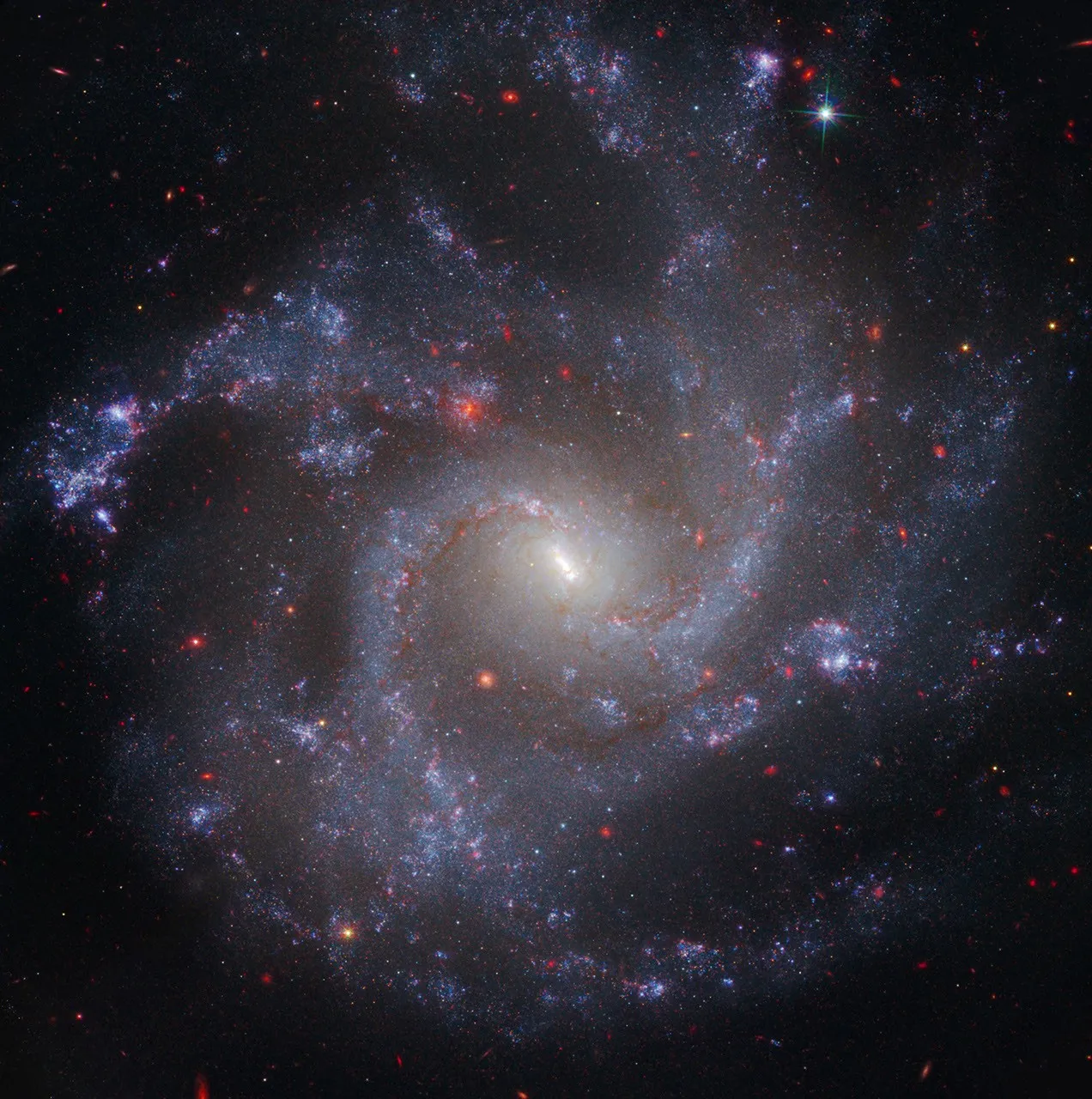
Better instruments arrived. The James Webb Space Telescope was pointed at the same nearby galaxies that Hubble had used, including NGC 5468, the spiral in the image above, about 130 million light-years away. Webb re-measured roughly a thousand of the pulsing stars that anchor the nearby end of the distance scale. If the older Hubble figure had been wrong because of crowded or dusty starfields, this was where the error would show.
It did not show. The two telescopes agreed with each other, which means the local measurement of 73 is solid, and the disagreement with the early-universe prediction of 67 is real.
That is Adam Riess of Johns Hopkins, who shared a Nobel Prize for the discovery that the expansion is speeding up, describing the result to NASA. His blunter version of the same thought: “what remains is the real and exciting possibility we have misunderstood the universe.” When two careful measurements refuse to meet and the measurements are not the problem, the problem is somewhere in the physics between them.
Why this is a data problem before it is a physics problem
Here is the part that turns a cosmology story into a computing one. The local measurement is built like a ladder. The bottom rung uses stars whose true brightness we know, so their faintness tells us their distance. Those calibrate the next rung, a kind of exploding star called a Type Ia supernova, which is bright enough to be seen across enormous distances and which is supposed to detonate with a standard brightness every time.
Supposed to. In practice a supernova is not a clean laboratory light. Its apparent brightness is smeared by the dust it sits behind, by the chemistry of the galaxy that hosted it, by the exact way that particular star tore itself apart. Every one of those effects is a small correction, and the final number is only as trustworthy as the corrections. This is exactly the kind of task, thousands of noisy images each needing a physically reasonable adjustment, where machine learning has started to earn its place.
What the models are actually being asked to do
Several groups are now bringing that toolkit to the messiest rung of the ladder. One line of work trains neural networks to model the environment around each Type Ia supernova, so the correction for dust and host galaxy is learned from data rather than hand-tuned. Another looks ahead to a rarer prize: supernovae whose light is bent and split into several images by the gravity of a galaxy in front of them. The tiny delays between those duplicate images are a direct handle on the expansion rate, with no ladder at all.
There are almost none of these gravitationally lensed supernovae on record, so researchers are training the models on simulations first, generating tens of thousands of synthetic lensed events, then preparing to turn the trained network loose on real data from the Nancy Grace Roman Space Telescope once it is observing. A July 2026 study went the other direction and squeezed the existing supernova catalogue harder, reporting a Hubble constant to about 1.1 percent precision from a re-calibrated dataset.
The stakes, stated plainly
It would be a tidy ending if artificial intelligence swept in and reconciled the two numbers. That is not the likely outcome, and it is worth being honest about why. If the models tighten the local measurement and the gap closes, the last decade was a story about stubborn measurement noise, which is a relief and a little dull. If the models tighten the measurement and the gap holds, the pressure moves off the astronomers and onto the theory of the universe itself.
That second outcome is the one physicists half-want and half-dread. It would mean the standard model of cosmology is missing something between the first light and the present day, some form of energy or physics we have not accounted for. The value of the machine learning here is not that it will pick a side. It is that it can strip away the ordinary explanations at a scale no team of people could, until the only thing left standing is either a boring correction or a genuinely new piece of the universe.
For once, the interesting result is the one where the tool fails to make the problem go away.
Image: NASA, ESA, CSA, STScI.